ChaosNetBench
Benchmark STGNNs where the dynamics are known and controllable.
ChaosNetBench provides a synthetic coupled-lattice benchmark with known topology and dynamics, while systematically varying local chaos, coupling and system size. This makes it possible to analyse when spatial modelling helps, how long predictions remain useful, and how rollout robustness changes across dynamical regimes.
Read the paper → arXiv:2605.0967696 system instances · 9,600 trajectories · 13 architectures · Public dataset
How ChaosNetBench works
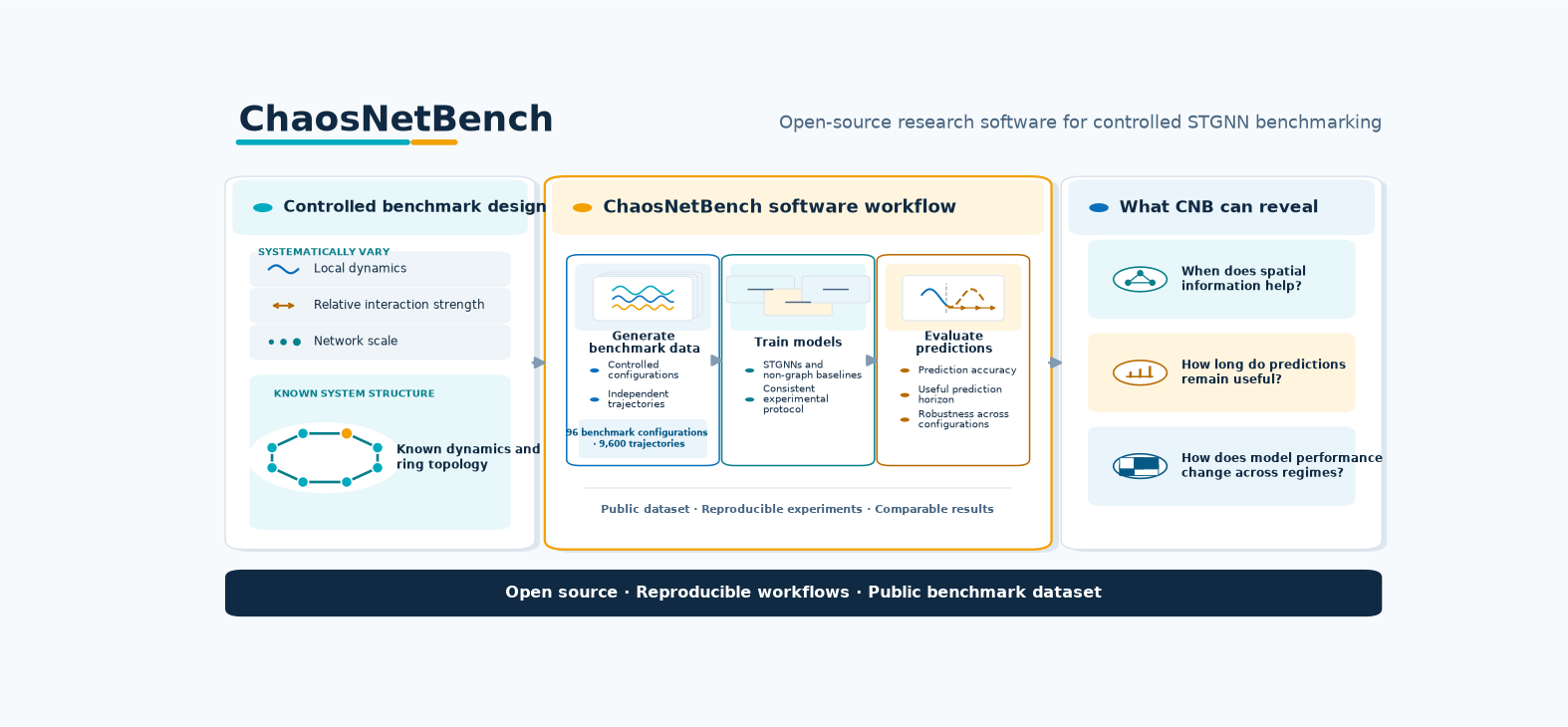
Benchmark data and reproducible workflows
Benchmark data
9,600 public trajectories across 96 controlled system instances, hosted on Hugging Face.
Controlled dataset generation
Reproducible generation from the coupled standard map using the public software and configuration.
Model experimentation
A public suite of 13 architectures: 5 STGNNs and 8 non-graph baselines.
Prediction evaluation
Valid Prediction Time, valid rollout, robustness and conditional accuracy across controlled conditions.
Reproducible benchmark sweeps
Structured multi-model and multi-seed sweeps with incremental result aggregation.
Research with ChaosNetBench
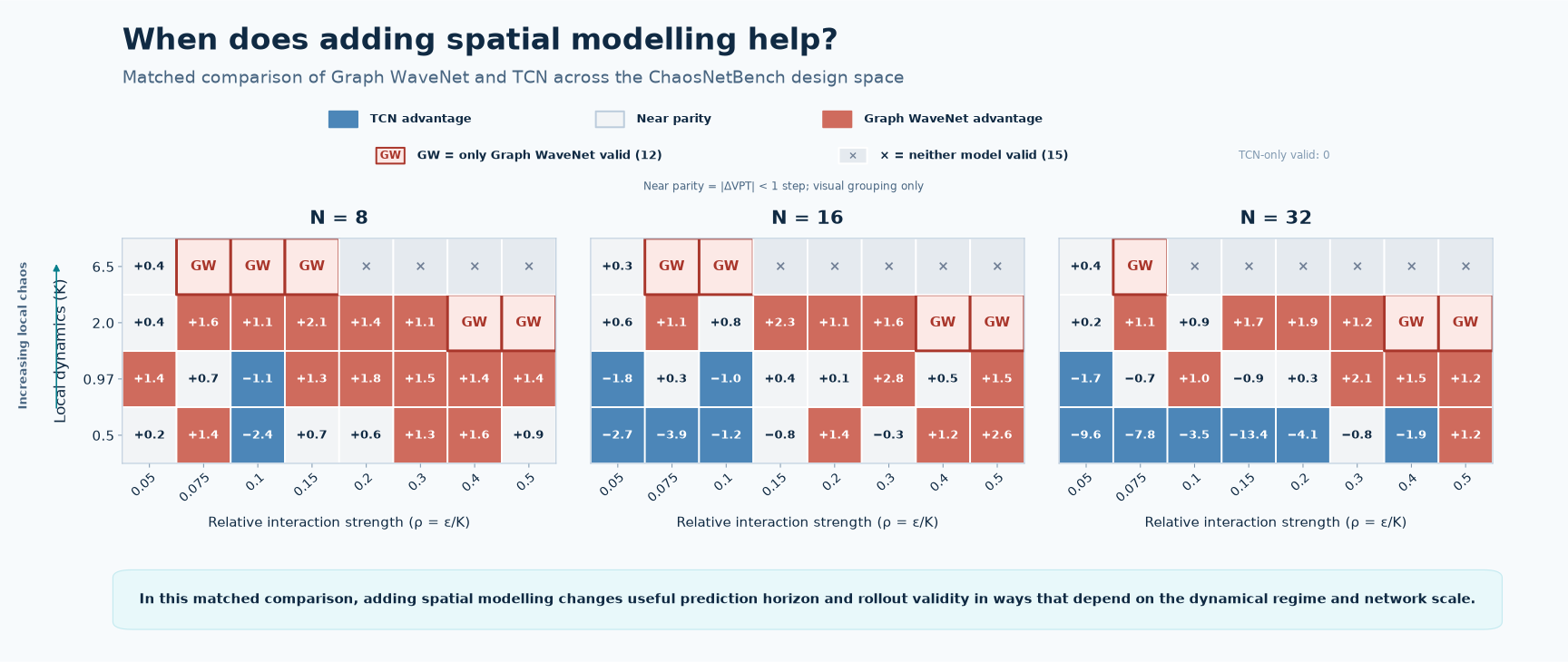
Benchmarking STGNNs across controlled dynamical regimes
ChaosNetBench enables controlled comparison of model behaviour across known dynamical conditions. A matched Graph WaveNet–TCN analysis illustrates how useful prediction horizon and rollout validity vary across the benchmark design space.
Explore the benchmark study →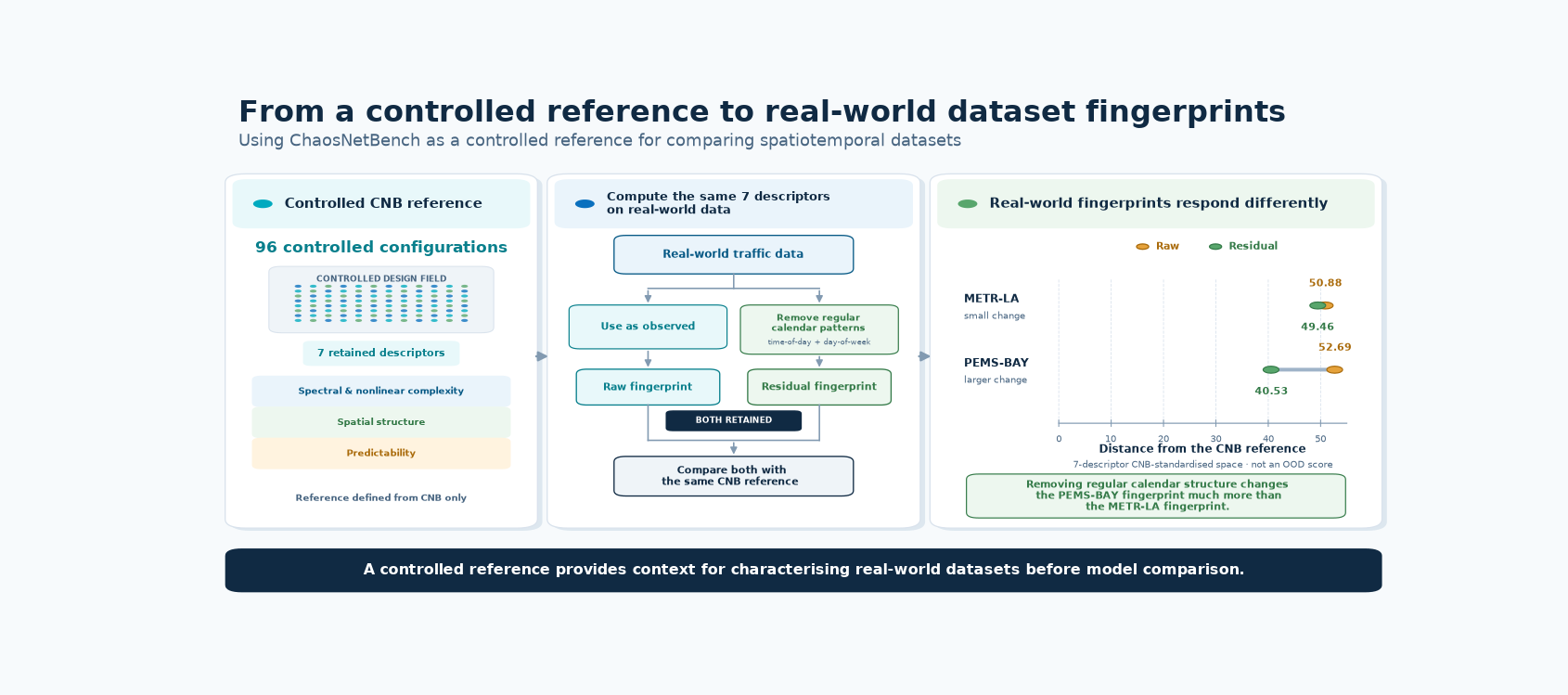
Dataset fingerprinting with a controlled reference
CNB also provides a controlled calibration reference for characterising observable structure in real world spatiotemporal datasets before model comparison.
Explore dataset fingerprinting →