Dataset fingerprinting
A Chaos-Informed Fingerprinting Framework for Analyzing Predictability in Spatio-Temporal Datasets
H. T. Moges · D. Moodley
Model selection in spatiotemporal forecasting is usually empirical: multiple architectures are trained on a dataset and compared using prediction scores. This work asks a complementary question: can the observable structure and predictability of the datasets themselves be characterised before model comparison?
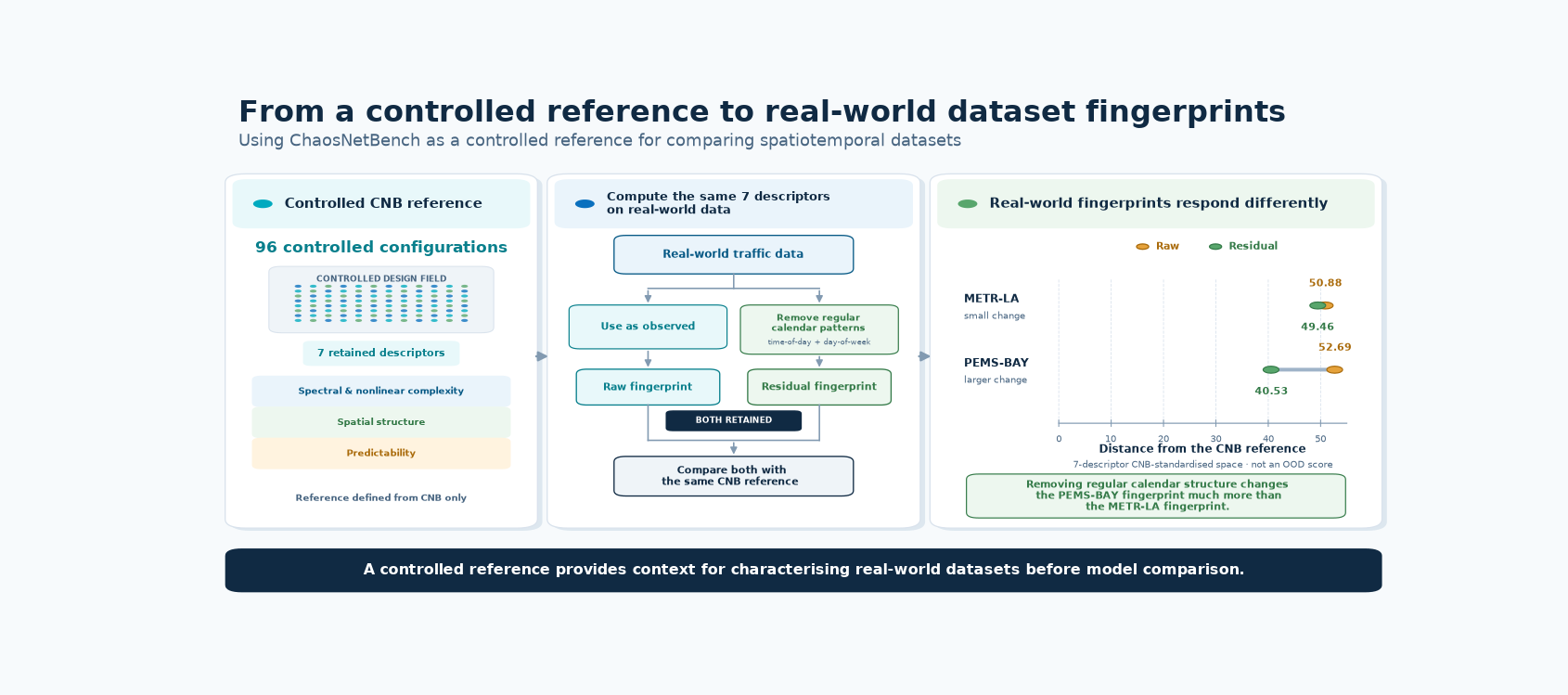
The framework represents each dataset using seven retained descriptors spanning spectral and nonlinear complexity, spatial structure and persistence-based predictability. ChaosNetBench supplies the controlled calibration reference, and the framework is demonstrated on METR-LA and PEMS-BAY using raw and seasonally residualised fingerprints.
Public result
Removing regular calendar structure changes the PEMS-BAY fingerprint much more than the METR-LA fingerprint.
Controlled reference
The seven retained descriptors provide compact coordinates for temporal, spectral and nonlinear complexity, spatial structure and persistence-based predictability. CNB supplies controlled variation against which these observable dataset properties can be characterised.
The calibration provides reference coordinates for observable dataset properties; it is not used as a generative model of the traffic data. The framework complements subsequent model comparison rather than replacing it.